
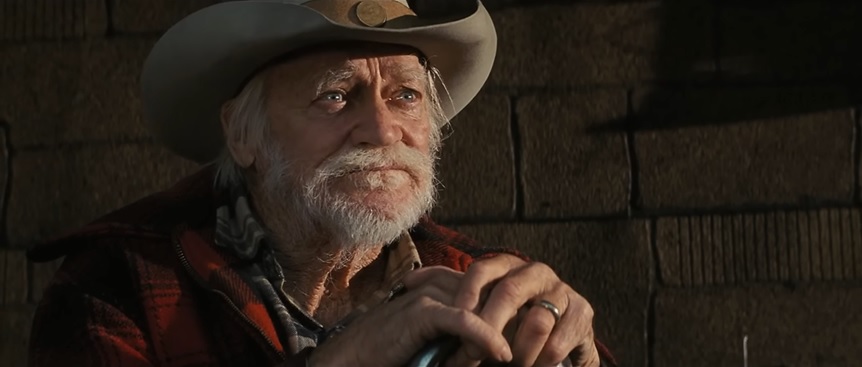

【 Chapter1 】 Film that doesn't Lynch-like ? No, it is not.
【 a 】 Consider David Lynch's unique film “The Straight Story ( 1999 )”, which Lynch died some time ago ( January 15, 2025 ). What makes it unique is that it is so straight - forwardly ordinary and full of human emotion, whereas Lynch's work has always provoked some sort of psychopathological interpretation.

【 b 】 However, that psychopathology is not unconditionally privileged as Lynch's own specificity. Lynch's work is the stagnation in cul-de-sac for people who cannot walk all the way down the street, in the sense that the stage is set in a town or a house that one steps into off the road or the street. This is most clearly indicated by the name of his work, “Lost Highway ( 1997 )”. In other words, its psychopathology is with the Road in the sense that it develops at cul-de-sacs off the road. And the way ( road ) lost to become the circular Mobius in “Lost Highway ( 1997 )” reappears as the straight Road in “The Straight Story ( 1999 )”.

【 Chapter2 】 What is the Road ( Way ) to Lynch ?
【 a 】 What must be considered here is what psychoanalytic significance the road had for Lynch. This is because what is called the Road ( Way ) is not the fixed concept for the unconscious. For some it is the paved road in some town, for others the country road, for others the itinerary through life, for still others the guiding path into the labyrinth of nightmares.
【 b 】 More to the point, in psychoanalysis, the Road ( Way ) becomes the Path that signifies that the subject has succeeded in facing himself. In Lynch's case, distortion is added to this psychoanalytic way, and the Road ( Way ) becomes the Path of many processes for the subject to get to himself.
【 c 】 In the worst case scenario, the Path becomes the circular Mobius that just goes round and round without ever reaching its own end. It is nothing but the nightmare in which the subject itself does not know where it is going. In it, the circuit in which the subject itself becomes the object of blindness operates as evil-infinity. The never-ending process itself, which the concept of “the Road ( way )” secretly contains, is extremized to evil-infinity.
This is because the concept of the Road ( Way ) itself remains after the destination is reached. In other words, the Road ( Way ) is the concept that symbolizes the process of walking itself, something that continues to exist independently of whether or not it reaches its destination.
【 d 】 This Path to the nightmare circuit is the essence of "Lost Highway", but "The Straight Story" is nothing more than Lynch's self-restoring work that brings this Path back to the Road ( Way ). Lynch, through the true story of Alvin Straight, unconsciously realized the importance of the Road, on which the very human's acting of Walk itself is based.
Walking is the engagement to the subject in the sense of supporting oneself on one's feet precisely, that is, psychoanalytically acting out. It might not be understood by those who have never experienced difficulty in walking.
【 e 】 In other words, Lynch intuitively realizes that the keep on walking, rather than getting off the street and staying in some town or house, is in itself the sacred thing that sustains human existence. Walking everywhere just to see someone. Walking even if physically handicapped ( Just as Alvin Straight and Richard Farnsworth were actually in the bad physical condition ). This sanctity makes human beings transcend the insularity of those who are mired in nightmares.
【 Chapter3 】 The unconscious fear of the infinity of the Road ( Way ).
【 a 】 In a sense, what Lynch's work has in common is his own unconscious fear of the infinity of the Road. Needless to say, the Road ( Way ) here must be considered in the symbolic sense, not merely the material one. One never knows where one is at on the road called life. Will he continue to live, or will he die soon ? Or where is the road leading one, a happy paradise or an unbearable hell ?
【 b 】 It is the terrifying infinity of such the Road ( Way ) that threatens Lynch unconsciously. The Road ( Way ) is the spatial figuration of the foundation of existence in which Human being stands on its own feet, that is to say, supports itself on its own feet. The difficulty in defining the Road ( Way ), however, lies in the structural mobility of the directionality, positioning, etc., which does not anchor Human in one place, but always carries them somewhere else.
【 c 】 It is that truth that makes Lynch unconsciously anxious. In this light, we can assume that the evil infinite that the protagonist in "Lost Highway" is forever objectifying himself in the circular Möbius does not truly represent the fear of Lynch. In other words, if you know, admittedly dimly, what you may be facing yourself, then it is not true fear. What is truly terrifying is that the Road ( Way ) carries human beings away to the point of self-disappearance where it no longer matters who they are.
【 d 】 So "Lost Highway" is quite the apt title. Because, the Road that has lost its direction, without knowing where it is headed, signifies that it has become the vicious Möbius, in which the protagonist has set himself up as the enigmatic object. So, in Lynch's work, the Road becomes the street or the avenue whose range is pre-divided by town blocks, or the psychological passageway where the protagonist has preliminarily narrowed his domain by his mental cul-de-sac.
【 Chapter4 】 The Story of the Road, or The Road Tells, or The Road Teaches.
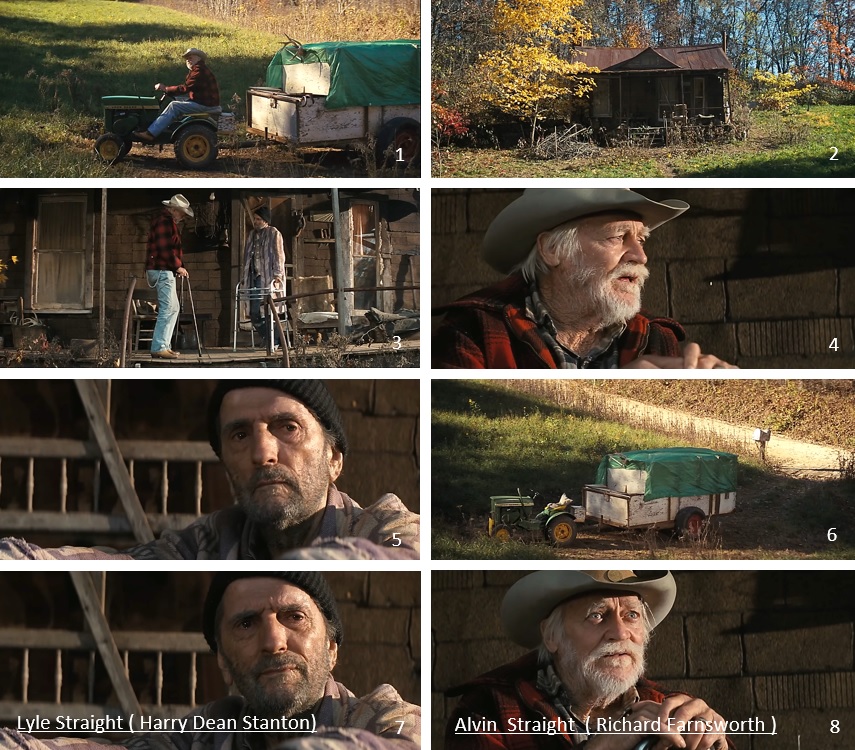
【 a 】 However, the Path that has been boundary defined regains its grandeur as the Road by "The Straight Story". The road teaches us that the subject must break out of his own diminutive world and walk toward someone else. The physical overcoming of vast distances makes possible the liberation from the mental 'cul-de-sac' by the subject.
【 b 】 Alvin Straight showed this by his actions, and Lynch learned it. That is why, as if to pay homage to him, Lynch attempted the steady and experimental method of filming this work, taking it in order from the point of departure.
【 END 】
