
〈 Continued from the previous article 〉

〈 Chapter 3 〉 People far from political ideology
〈 a 〉 If that is the case, then who is the resentment that Godzilla / Ghost holds directed at ? It would be easy to answer that it is broadly speaking all of Japan. There is nothing wrong with answering that question, but before jumping to any conclusions, it would be interesting to think about who in Japan it is directed at.

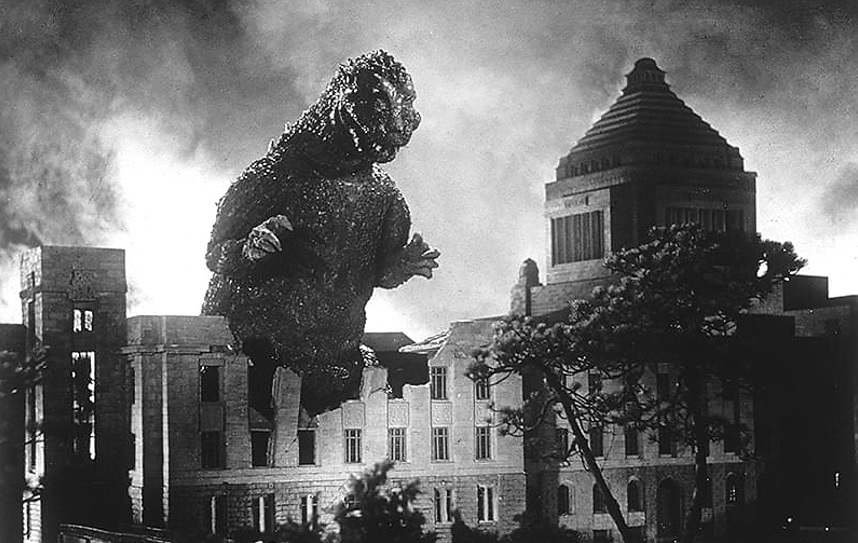
〈 b 〉 Hint about this is hidden in Godzilla's rampage in Japan. Norihiro Kato has this to say about it :
In this nighttime scene, Godzilla heads from Ginza towards the city center, trampling over the Metropolitan Police Department at Sakuradamon. After reaching the National Diet Building and destroying it, he then changes direction and heads back towards the Sumida River. Kawamoto Saburo makes an interesting point about Godzilla's "1954 turn". Godzilla is likely made up of people killed in the war, but even he was unable to trample over the Imperial Palace, which shows how much the curse of the imperial system extends to every single blade of grass on Japanese soil.
In response to this, folklorist Akasaka Norio presented a different idea in 1992, echoing Kawamoto's theory. Akasaka's view is comparable to Mishima Yukio's "Voices of the Heroic Spirits," and he argues that Godzilla, who also died in the war, came to see the emperor, but that the emperor, the supreme commander and living god who had sent them to the battlefield, was no longer present at the Imperial Palace, that the emperor had declared himself human and was now under the control of the new god, America, and that he had abandoned them, so Godzilla turned on his heels and left.
While paying tribute to Kawamoto Saburo, who first mentioned Godzilla's "1954 turn," I would like to adopt Akasaka's interpretation of it. Godzilla appeared in Japan after the deity known as the emperor was gone, and he points to the original place, so to speak, of the hearts of postwar Japanese people. Godzilla has returned to postwar Japan not because he is no match for the Emperor's magical power, but to make it clear to everyone that Emperor Showa is no longer the source of that magical power. The depth of the suffering of Godzilla ( the war dead ), along with his magical power, now exceeds that of the Emperor. Godzilla's magical power should now replace the power of the Emperor.
"Goodbye, Godzillas" p. 154~155, from "Goodbye, Godzillas : Far Away from the Postwar" by Norihiro Kato, Iwanami Shoten ( 2010 )
* The above quotation is personal translation from the original text, and the underlining is also by me, the author of this article.
〈 c 〉 What is indigestible about Kato's consideration is that even if Godzilla is trying to show whether the power of the emperor system is still valid or not, he does not clearly state “to whom” Godzilla is trying to show it if it is not directed at the emperor himself. To be precise, it can only be addressed to the Japanese people. In other words, the real issue is not the emperor system, Japan's ruling structure ( as represented by the ideological interpretation of whether or not it is still in effect toda y), or the US itself, which has taken power away from the emperor, but rather Godzilla is angry at "unprincipled people", regardless of ideological beliefs, who are “weathercocked” into submission.
〈 d 〉 This means that arguments for and against the Emperor System by Saburo Kawamoto and Norio Akasaka, and ghost theory by Norihiro Kato, also emphasize too much on "what" is returning, making the fundamental question of "where / to whom" it is returning unclear. It's fine to discuss power itself, but the problem is that unless we consider what and who supports that power, the structure will not change no matter who holds the power, whether it's the Emperor or the United States. Furthermore, even if the people overthrow a certain power system, they themselves cannot destroy their own structure of belonging to the state. If they could do that, then the people would only be subject to another state power ( such as Russia or China ). This means that after the overthrow, a new power structure to run the state will inevitably be born, and the people have no choice but to follow that political phenomenon "in their daily lives", and they know this unconsciously. In other words, the problem is not a particular type of power, but the fact that the power structure itself is based on the implicit support from below of the "non-ideological conformity" of the majority of the people.
〈 e 〉 In that sense, Kato's desire to entrust Godzilla with the symbolic destruction of the state power system in his Godzilla theory is nothing more than a political assertion that reflects the privileged consciousness peculiar to intellectuals who are unable to grasp the unconscious essence of the film, which is Godzilla's rage towards the people. The assertion itself is up to him, but it cannot be denied that there is the aspect to it where he is overusing the symbol of Godzilla for his own political assertion.
However, if another Godzilla movie is made, I would love to be part of the scriptwriting team. In my opinion, there is still something Godzilla has left to do. He cannot rest in peace until he does this. Here is my idea : Godzilla comes again. He lands on Tokyo off the coast of Shinagawa. I hope it is at night. This Godzilla goes somewhere he has never been before.
His destination is Yasukuni Shrine.
Godzilla destroys Yasukuni Shrine.
Ibid. p. 173
* The above quoted passage is personal translation from original text, it's by me, the author of this article.
〈 Chapter 3 〉 Godzilla reaches the public only as the thing entertained in the movie, not as the symbol of wartime.
〈 a 〉 Norihiro Kato's theory on Godzilla is brilliant, but it has logical flaws because, no matter how much he exposes the unconscious political nature of the symbolism that Godzilla is entrusted with, he does not consider the logical meaning that it reaches to the public only as the thing entertained in the film. No matter what political meanings the filmmakers of Godzilla may have imbued Godzilla with ( including anti-H-bomb, peace, etc. ), these hidden meanings do not reach the public directly.
〈 b 〉 Godzilla was able to be widely recognized by the public precisely because it was transformed into the thing entertained in the movie that sublimated its political nature. If Godzilla had been directly portrayed as the political symbol from the beginning, the public would not have been able to enjoy it openly due to its political nature, and would have been put off by it. In other words, being enjoyed without thinking about anything extraneous ... this is the minimum requirement for entertainment.
To put it more precisely, Thing entertained called Godzilla is not so much the direct sublimation of politics, but rather is Thing as figure of "Enjoyment ( psychoanalytical concept )" embodies "Non-thinking" itself. And that Enjoyment can be enjoyed without thinking about politics, even though it is wrapped in politics.
〈 c 〉 The film certainly contains clear political messages about the horrific experiences of past wars and the devastating dangers of hydrogen bombs, but the threat of such realpolitik is neutralized in the face of entertainment. This is not limited to Godzilla, but the entertainment of film itself has the intensity to weaken political ideologies that suffocate the masses ( of course, it goes without saying that there are many films that are imbued with politics ). In this sense, we should think of Godzilla as having been born from the reality of people's wartime experiences, and that, although its imagery still retains the color of war, it has been generated as the new thing entertained that is different from war.
〈 d 〉 So, for Ishiro Honda himself, Godzilla was the generated thing that sublimated the psychological pressure of his wartime experiences. While it was an image of war, it was also the "adjacent object" that "indirectly" separated him from war. Rather than directly conveying the threat of war as a message, it softened the misery of reality by indirectly weakening it by turning it into entertainment. Godzilla was also the "de-dimensional object" that coexisted with "the continuation of the past of war experience" and "the free future that is not bound by war forever".
〈 e 〉 This is also reflected in Honda Ishiro's thoughts on his own wartime experiences. In "Honda Ishiro : Godzilla and My Life," the interview book by Yamamoto Shingo, Honda repeatedly speaks about his rejection of war and his belief in pacifism. However, he adds that as a young soldier, he realistically adapted to the situation, believing he would not have survived if he had not followed the rules. He also says that what sustained him was the desire to survive the war, return home, and make films again, and that in that sense he was not a good soldier in the sense of sacrificing himself.
( Yamamoto ) Here, I'd like to mainly ask you about your war experience. Going to the battlefield means that death is a very real possibility.
( Honda ) Yes. But my way of life was to give myself the self-suggestion that I definitely wouldn't die in the war. If I hadn't, I think I might have gone crazy. It was nothing more than the self-suggestion that I would definitely come back. I think that's what kept me alive. < Omitted >
That was my way of life, completely. I couldn't die from a bullet. I would have to go back and work in movies again, and there would have been no point in living. So I told my wife that everything would be fine. She never asked me to fight honorably. In that sense, I may not have been a very good soldier...
"Honda Ishiro : Godzilla and My Life" p. 218~220 Interview and composition by Yamamoto Shingo, Jitsugyo no Nihonsha ( 1994 )
* The above quoted passage is personal translation from original text, it's by me, the author of this article.
( Yamamoto ) From your experience, what do you think war is ?
( Honda ) I don't know. It depends on the situation at the time. < Omitted >.
But war is difficult to understand. War is boring. < Omitted >.
I was like, "I'm not going to die over something like that..." I would have done otherwise. But even so, I told my friends and the guys who were being called up, "I won't die even if Japan loses, I have a child, I go back to Japan once, see my wife, and see what Japan will become". I even joked that if I was being chased, I would run all the way to the top of the Himalayas. I just couldn't accept dying in war. But even so, the way I serve in the military is my way of life, and if I find myself in that situation, I won't do what I have to do carelessly. It's not like I'm against war with a real ideology. I was just living my life as an ordinary person. If that was all I had done back then, and if I had really opposed it, I probably would have died.
Ibid. p. 220~222
* The above quoted passage is personal translation from original text, it's by me, the author of this article.
〈 f 〉 For all of the above, Honda did not turn to the entertainment of movies after the war ended, but maintained the strong will to film even while in the military. Far from suffocating his passion for film, the field of film, which he saw as more valuable than war, continued to live on within him. That's why he never lost the desire to return from the war alive. Yes, he was not a man of ressentiment or regret, but someone who maintained the strong will to live. He lived not for a nation with military power, but for human beings, and for the entertainment that entertained them.
〈 g 〉 Considering this, Kato's theory "Godzilla = Ghost" doesn't seem to suit Ishiro Honda very well. It may not be easy for humans to escape from the relentless return of the past, but if humans defeating Godzilla is not the break from the curse of the past, then what is it ? I think Ishiro Honda unconsciously knew that entertainment can free Human from the political curse of the past, and that entertainment has the power to set Human free ( of course, the "sin of ignorance" that could lead to the repetition of the past still remains ). In that case, Godzilla's ghostly invasion is not so much the weathervane of anger towards the people as it is the opportunity to consciously depict the reality that the people are always victims of war. If you read the interview book with Honda quoted above, you can see that he hated war and was worried about the people becoming victims.
【 END 】
